
Recently, the research group led by Associate Professor Jingwei Chen from the College of Materials Science and Engineering at Ocean University of China (OUC) developed an optically transparent, electrochemically stable, and flexible zinc mesh anode, which was successfully applied to large-area, multicolor electrochromic devices. The related work, entitled “Durable and Flexible Zinc Mesh Anodes for Scalable and Fast-switching Electrochromic Devices,” was published in the internationally recognized journal npj Flexible Electronics (IF: 15.5). Ocean University of China is the first affiliated institution, Associate Professor Jingwei Chen is the corresponding author, and Guolong Zhou, a master’s student (Class of 2023), is the first author.
With the rapid development of the Internet of Things era, electrochromic devices (ECDs) featuring dynamic optical modulation and high energy efficiency have attracted increasing attention in optoelectronics, flexible electronics, and wearable technologies. As a new multifunctional electrochromic platform, zinc-based electrochromic devices (ZECDs) offer advantages such as energy recyclability and intrinsic charge balance. However, the use of opaque zinc foil anodes often leads to non-uniform electric-field distribution and zinc dendrite growth, severely limiting cycling stability and device lifetime. To address these issues, the research team employed a coupled “electrodeposition–in situ displacement” strategy to construct Ag–PVDF-coated zinc mesh (AP@Zn) anodes with excellent electrochemical performance and optical transparency. This design effectively enhanced the reaction kinetics and durability of zinc-based electrochromic devices while enabling scalable fabrication and multicolor switching capabilities.
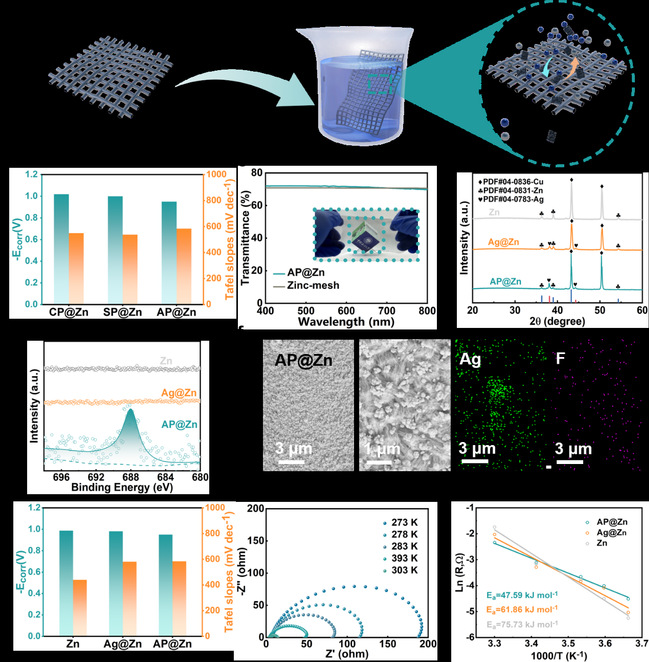
Figure 1 Preparation and characterization of AP@Zn net anodes
The study demonstrates that the Ag–PVDF coating significantly improves corrosion resistance and reduces hydrogen evolution current density, while maintaining high optical transmittance (71.4% at 633 nm). The PVDF molecular chains regulate the uniform growth of silver nanoparticles, and strong dipole interactions between polar C–F bonds and the silver surface enhance coating adhesion. Mechanical tests show that AP@Zn maintains structural integrity and electrochemical stability after 1,000 bending cycles. In addition, the low activation energy (47.59 kJ mol⁻¹) of AP@Zn markedly improves electrode reaction kinetics.
Through systematic structural design and interfacial engineering, the AP@Zn anode promotes uniform electric-field distribution and effectively suppresses zinc dendrite formation, resulting in significantly enhanced switching speed and cycling stability of electrochromic devices. The PB//AP@Zn mesh device achieves ultrafast coloration/bleaching times (3.0 s / 2.8 s), nearly three times faster than conventional zinc-foil-based devices, along with a high coloration efficiency of 157.44 cm² C⁻¹. The device also exhibits excellent cycling stability and energy-storage functionality, enabling an integrated “energy storage–display” smart system. Furthermore, the study demonstrates the applicability of AP@Zn electrodes in large-area devices (100 cm²) and multicolor electrochromic displays, providing valuable insights for the application of electrochromic technologies in energy-efficient smart windows, flexible electronics, and wearable devices.

Figure 2 Electrochromic properties of Prussian blue-AP@Zn
This work was supported by the National Natural Science Foundation of China, the Shandong Outstanding Young Scientists Fund (Overseas), the OUC Young Talents Start-up Fund, and the Fundamental Research Funds for the Central Universities, among others.
Original Article Link: https://doi.org/10.1038/s41528-025-00509-1
Text/Images: Zhou Guolong