
Recently, the research group led by Associate Professor Jingwei Chen from the College of Materials Science and Engineering at Ocean University of China (OUC) has achieved significant progress in the field of photothermal-regulated electrochromic smart windows for energy-efficient buildings. The related research outcomes have been published in the internationally renowned journals Nature Communications and ACS Energy Letters, while a comprehensive review has appeared in Nature Reviews Clean Technology.
Modern buildings account for approximately 40% of global energy consumption, with windows responsible for substantial heat and light exchange between indoor and outdoor environments, resulting in low energy efficiency. Dynamic photothermal-regulation smart window technologies offer promising solutions for reducing building energy consumption. Among various smart window technologies, electrochromic smart windows based on reversible metal electrodeposition (RME) exhibit advantages such as simple device structures and broadband spectral modulation with color-neutral appearance. However, challenges remain, including insufficient electrode–electrolyte interfacial stability, which affects deposition/stripping kinetics, chemical and electrochemical stability, as well as weather resistance and large-scale fabrication. Developing electrolytes that are fast, efficient, biocompatible, and environmentally friendly has become a critical bottleneck for practical application.
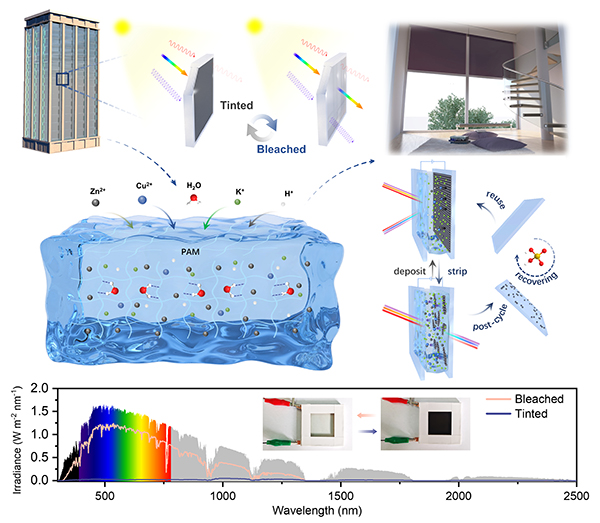
Figure 1. Schematic diagram of quasi-solid copper-zinc bimetallic reversible electrodeposition intelligent window and photothermal regulation
To address these challenges, the research team—collaborating with Professor Huanlei Wang of OUC and Academician Lee Pooi See from Nanyang Technological University, Singapore—designed a quasi-solid-state hydrogel electrolyte composed of Cu/Zn dual-metal salts and a polyacrylamide network. By optimizing the Cu/Zn ratio and pH value, the team achieved highly reversible Cu–Zn deposition/stripping processes. The resulting device demonstrated a 78% optical modulation range, long-term cycling stability exceeding 3,000 cycles (with over 90% optical modulation retention), and rapid coloration/bleaching switching speeds.

Moreover, the hydrogel electrolyte effectively suppressed strong hydrogen bonding among water molecules, significantly enhancing anti-freezing performance down to –20 °C. In recyclable quasi-solid-state smart windows, the electrolyte enabled leakage prevention, long memory effects, patternability, and highly efficient thermal insulation. The smart windows achieved energy savings of 18% to 33% across different global climate zones, demonstrating excellent cost-effectiveness and durability. The related paper, entitled “Recyclable quasi-solid-state dynamic windows via reversible dual-metal electrodeposition for building energy modulation,” was published in Nature Communications. Bing Xu, a Ph.D. candidate (Class of 2023) in Marine Materials Science and Engineering, is the first author, and Ocean University of China is the primary corresponding institution.
In earlier work, the team also developed a smart window technology based on gradient reversible alloy electrodeposition (CuZn-RAE). Leveraging the higher electrochemical reduction potential of Cu ions and their strong zinc affinity, the system enables preferential copper nucleation to guide subsequent zinc deposition in Cu–Zn electrolytes. This gradient deposition mechanism significantly reduced deposition activation energy to 19.2 kJ mol⁻¹, resulting in uniform nanospherical deposits, a high optical modulation range of 82%, and color-neutral appearance. The device exhibited enhanced response speed, excellent stability (optical modulation retention >92% after 1,400 cycles), and superior photothermal regulation performance. The related article, “Color-Neutral Smart Window Enabled by Gradient Reversible Alloy Deposition,” was published in ACS Energy Letters. The first author is Yingxin Zhang, a master’s student (Class of 2022) in Materials Engineering, with OUC as the corresponding institution.
Building upon continuous research in photothermal-regulated electrochromic smart windows, the team—together with collaborators from Shandong University and the University of Alberta (Canada)—systematically reviewed the operating mechanisms, fabrication processes, and implementation strategies of inorganic electrochromic smart windows (ESWs). The review comprehensively analyzes the relationships among energy efficiency, material selection, electrochemical processes, and photothermal regulation properties. It highlights the advantages of dual-band modulation and reversible metal deposition technologies in inorganic ESWs and emphasizes the importance of improving cost-effectiveness, scalability, and long-term durability. The review, titled “Inorganic electrochromic smart windows for advancing building energy efficiency,” was published in Nature Reviews Clean Technology, with Ocean University of China as the corresponding institution.
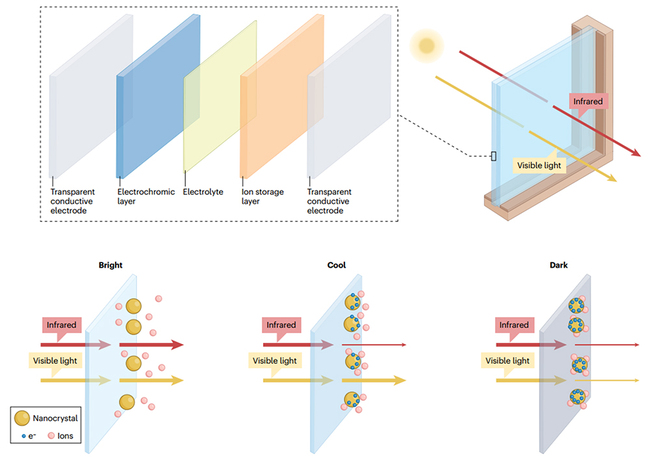
Figure 3. Photothermal regulation mechanism of electrochromic smart windows
This series of studies was supported by the National Natural Science Foundation of China, the Shandong Outstanding Young Scientists Fund (Overseas), and the OUC Young Talents Start-up Fund, among others. Jingwei Chen, Associate Professor under the OUC Young Talents Program (Category II), focuses on high-performance electrochemical energy storage and energy-saving materials and devices, including interfacial charge/mass transfer kinetics, photothermal regulation mechanisms of electrochromic materials and devices, and multifunctional electrochromic energy storage systems. As first or corresponding author, he has published over 40 SCI-indexed papers in leading journals such as Nature Communications, Nature Reviews Clean Technology, Energy & Environmental Science, Angewandte Chemie, ACS Energy Letters, Advanced Energy Materials, and Advanced Functional Materials.

Group photo of the team (third from left in the first row is Associate Professor Chen Jingwei)
Text: Bing Xu
Article Links: https://doi.org/10.1038/s41467-025-66963-7
https://doi.org/10.1021/acsenergylett.4c01677
https://www.nature.com/articles/s44359-025-00065-xEditor: Zhao Xiyun
Responsible Editor: Liu Li