
A research team from the China–Australia International Joint Research Center for Functional Molecular Materials at Ocean University of China’s School of Materials Science and Engineering, working with the Technical Institute of Physics and Chemistry of the Chinese Academy of Sciences, the Australian National University and other institutions, has made advances in high-symmetry one-dimensional polar perovskites for optical applications.
Through the coordinated design of chiral π-conjugated organic cations and metal ions with lone-pair electrons, the team constructed six hexagonal, uniaxial organic–inorganic hybrid perovskites, (R-/S-HEP)BI₃, where B is Ge, Sn or Pb. The germanium-based crystal powders exhibited a second-harmonic generation response 15 times that of the benchmark crystal potassium dihydrogen phosphate, KH₂PO₄ (KDP). The crystals also showed birefringence values ranging from 0.518 to 0.595 at 546 nm.
The findings were published in the Journal of the American Chemical Society under the title “Record Second-Harmonic Generation and Exceptional Optical Anisotropy in High-Symmetry 1D Polar Perovskites.”
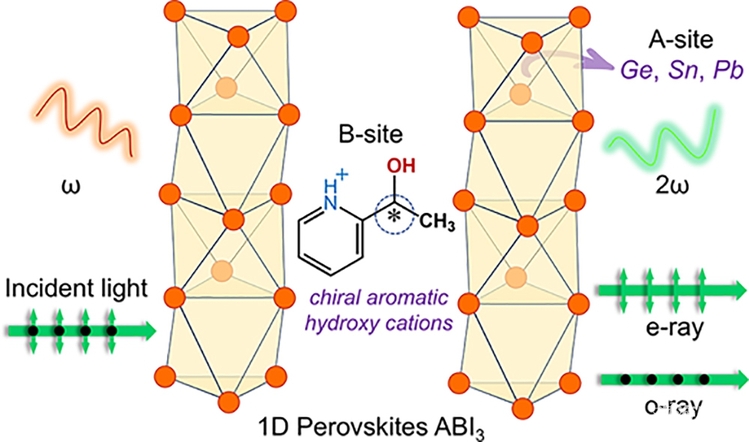
Second-harmonic generation and birefringence are fundamental to laser frequency conversion and optical polarization control. They have potential applications in laser technology, high-resolution imaging, optical communications, quantum and integrated optics, and precision micro- and nanoscale processing, as well as in areas such as laser-driven nuclear fusion, infrared optoelectronic countermeasures and high-energy strike systems.
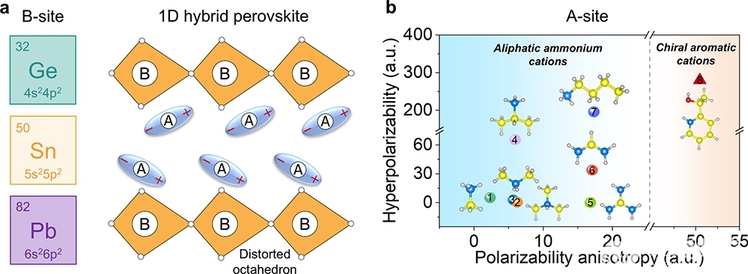
Organic–inorganic hybrid perovskites offer a versatile platform for optimizing linear and nonlinear optical properties because their composition and structure can be widely adjusted. However, hybrid perovskites with strong optical anisotropy often crystallize in structures of low symmetry. Achieving both a strong second-harmonic response and high birefringence while maintaining a high-symmetry uniaxial structure remains a major challenge.
The team introduced chiral R-/S-2-(1-hydroxyethyl)pyridinium (R-/S-HEP) as the A-site organic cation in germanium, tin and lead iodide systems. The π-conjugated electron structure of the pyridine ring gives the organic group high hyperpolarizability and polarizability anisotropy, while intermolecular hydrogen bonding involving the hydroxyl group provides additional control over crystal assembly.
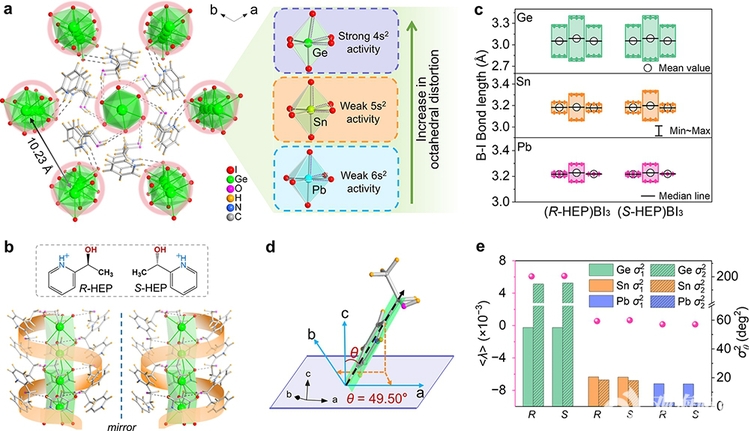
Single-crystal structural analysis showed that all six crystals belong to the non-centrosymmetric polar space group P6₃. Face-sharing [BI₆] octahedra form one-dimensional inorganic chains, with organic cations arranged between adjacent chains. Hydrogen bonding transfers molecular chirality to the crystal structure, and circular dichroism measurements revealed optical responses of opposite signs for the two chiral configurations.
By retaining the same organic cation and systematically replacing the B-site metal, the researchers demonstrated the significant influence of lone-pair stereochemical activity on second-harmonic generation. Under excitation with a 1,200 nm fundamental laser, both R- and S-configured germanium-based crystal powders, with particle sizes of 200–280 μm, produced a response 15 times that of KDP. This was substantially higher than the responses of the tin-based crystals, at 0.7 times KDP, and the lead-based crystals, at 0.45–0.5 times KDP.

Further measurements showed that, under excitation at a fundamental wavelength of 2,000 nm, both germanium-based crystal powders produced a second-harmonic response equal to that of potassium titanyl phosphate (KTP) and exhibited phase-matching behavior. These results indicate potential for laser frequency conversion across visible and near-infrared wavelengths.
The crystals also exhibited strong optical anisotropy. Polarized optical microscopy showed that the birefringence of all six crystals exceeded 0.5 at 546 nm, ranging from 0.518 to 0.595. The two germanium-based crystals had birefringence values of 0.518 and 0.529, while the S-configured lead-based crystal reached 0.595. Their high birefringence combined with a hexagonal uniaxial structure provides a new example for the design of high-symmetry optical materials. Uniaxial crystals have a clearly defined optical axis, which can simplify the orientation, fabrication and assembly of optical components.
First-principles calculations provided insight into the mechanisms behind these properties. In the germanium-based crystals, the greater stereochemical activity of the Ge²⁺ lone-pair electrons causes more pronounced off-center distortion of the [GeI₆] octahedra. The ordered arrangement of the inorganic octahedra along the chains, together with the aligned polarization of the π-conjugated HEP cations, contributes to the strong macroscopic second-harmonic response.
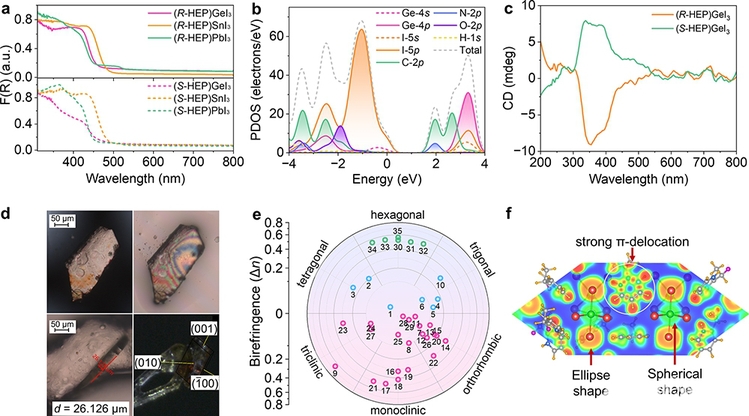
The theoretical analysis also indicated that the exceptionally high birefringence arises mainly from the delocalized π electrons and ordered arrangement of the HEP cations, while the inorganic chains help regulate their spatial arrangement. These findings clarify the different roles of the A-site organic cations and B-site metals in controlling linear and nonlinear optical properties, providing a basis for optimizing both through composition and structural design.
The study expands the design possibilities for hybrid perovskites as functional optical crystals. In particular, the germanium-based crystals offer lead-free candidates with strong nonlinear optical responses for further research into frequency conversion, polarization control and related optoelectronic devices.
The research was supported by Shandong Province’s dedicated program for recruiting leading talent, the National Natural Science Foundation of China’s General Program and Key Program of Joint Funds, and the Australian Research Council.
Text: Li Wei
Paper: https://doi.org/10.1021/jacs.6c06238
Editor: Peng Yuxin
Responsible editor: Liu Li