
Recently, the research group led by Associate Professor Chen Jingwei from the School of Materials Science and Engineering at Ocean University of China (OUC) has made new advances in the multifunctional integration of dynamic optothermal regulation devices. The related findings have been published in the internationally renowned journals Advanced Functional Materials and Advanced Science.
Driven by the dual demands of China’s carbon peaking and carbon neutrality goals and information security in the Internet of Things (IoT), multimodal, broadband, and multifunctionally integrated dynamic optothermal regulation devices have opened up new possibilities for dynamic information encryption and intelligent optothermal management in buildings. However, current electrochromic systems still face several fundamental challenges. Conventional electrochromic devices offer limited dimensions of optical modulation, making it difficult to simultaneously achieve multilevel information transmission in the transmissive state and comprehensive information concealment in the reflective state. Meanwhile, conventional electrochromic or thermochromic smart windows generally respond to a single external stimulus, and their insufficient capability to simultaneously block visible and near-infrared light limits their practical energy-saving performance.
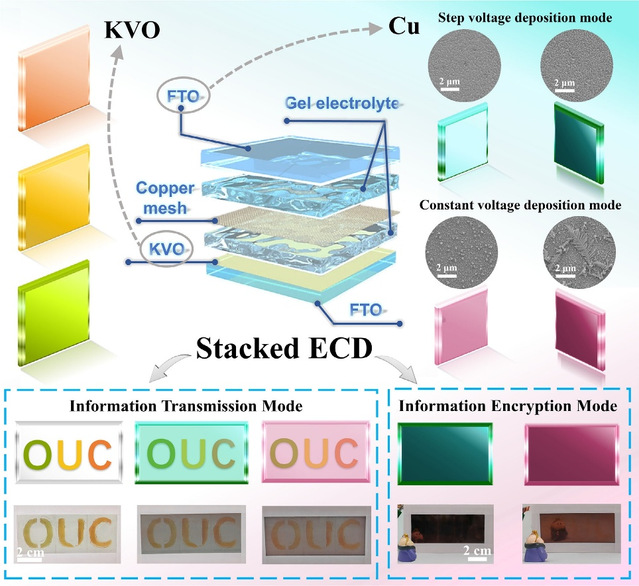
Figure 1 Structural schematic diagram of stacked transmission/reflection multicolor electrochromic device, information transmission/encryption mode, and actual product photo
Therefore, expanding the number of tunable optical states and integrating electrochromic and thermochromic mechanisms for synergistic regulation have become key challenges in developing multifunctional electrochromic devices for both information security and improved building energy efficiency. To address these issues, Chen’s group employed electrode stacking and precise spectral-complementarity design based on dual-mechanism coupling to develop a stacked dual-mode chromic device and a dual-responsive electro-thermochromic smart window. These studies provide viable approaches for high-level anti-counterfeiting and low-carbon buildings, respectively, and establish a new technological framework in which electrochromic materials contribute to both information security and building decarbonization.
In the stacked dual-mode chromic device, the researchers combined color switching in a K⁺-doped vanadate (KVO) electrode with localized surface plasmon resonance in a copper-based reversible metal electrodeposition (Cu-RME) electrode, achieving a stacked transmissive/reflective multicolor electrochromic device. The KVO electrode enables rapid switching among green, yellow, and orange states with a low activation energy. Meanwhile, by adjusting the deposition voltage, the Cu-RME electrode can rapidly switch among multiple optical states, including transparent, blue-green transparent, purple-red transparent, and mirror states.
By stacking the two electrodes, the electrochromic device can switch between a multicolor transmissive mode and a reflective mode, enabling a wide range of potential applications, including non-emissive displays, adaptive camouflage, infrared thermal management, multistate information transmission in the transmissive mode, and dynamic information encryption in the reflective mode.
The findings were published in Advanced Functional Materials under the title “Dynamic Information Transmission and Encryption by Stacked Electrochromic Device.” Zhu Mengjie, a 2023 master’s student in Materials Engineering at the School of Materials Science and Engineering, is the first author of the paper, with Ocean University of China serving as the primary corresponding institution.
In the dual-responsive electro-thermochromic smart window, the researchers designed and assembled a dual-responsive smart window by coupling an anodically coloring Prussian blue (PB) electrode with a hydroxypropyl cellulose (HPC)-based hydrogel electrolyte. The HPC hydrogel electrolyte provides large thermochromic transmittance modulation, high mechanical stability, and high ionic conductivity, enabling the PB electrode to achieve high coloration efficiency and rapid switching kinetics.
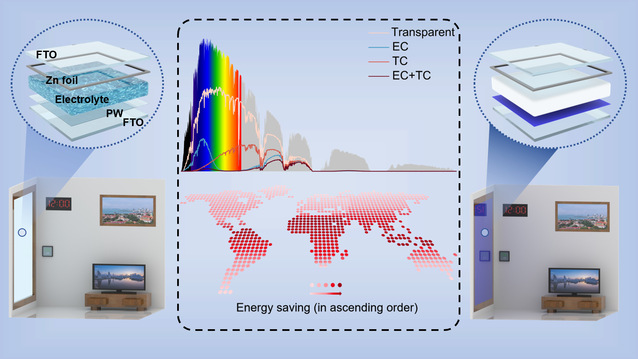
Figure 2 Schematic diagram of the structure and operation of the electric-thermal dual-response smart window, as well as spectral modulation and global energy-saving effect diagram
The assembled smart window features four distinct operating modes: a transparent state, an electrochromic state, a thermochromic state, and a combined electro-thermochromic state. Through optimized spectral complementarity, the system enables effective regulation across a broad portion of the solar spectrum. On-site thermal regulation tests and building energy simulations further demonstrated its excellent optothermal regulation capability. In particular, the dual-responsive smart window can substantially reduce building energy consumption in low-latitude regions, demonstrating considerable potential for energy conservation and carbon-emission reduction.
The findings were published in Advanced Science under the title “Advancing Energy Efficiency in Smart Windows via Dual-Responsive Electro-Thermochromism.” Chen Tongyu, a 2024 master’s student in Materials Engineering at the School of Materials Science and Engineering, is the first author of the paper, with Ocean University of China serving as the primary corresponding institution.
The research was supported by the National Natural Science Foundation of China, the Shandong Provincial Excellent Young Scientists Fund Program (Overseas), and the Fundamental Research Funds for the Central Universities.
Original Articles: https://doi.org/10.1002/adfm.76530
https://doi.org/10.1002/advs.77055
Text and Figures: Chen Tongyu