
Recently, the research group led by Professor Wu Jingyi from the School of Materials Science and Engineering has made a series of advances in seawater-based zinc energy storage. The related findings have been published in the internationally renowned journals Advanced Energy Materials, Advanced Functional Materials, and Energy Storage Materials.
Driven by the growing demands for coastal renewable energy integration and deep-sea exploration, seawater-based zinc-ion batteries have emerged as a promising direction for marine energy storage due to their high compatibility with marine environments. Among them, seawater-based zinc–iodine batteries have attracted considerable attention because multielectron redox couples offer the potential to achieve high energy densities.
However, the coexistence of high concentrations of Cl⁻ and water molecules in seawater-based electrolytes presents major challenges. In particular, Cl⁻-induced corrosion of the zinc anode and hydrolysis of highly reactive I⁺ intermediates at the cathode interface severely compromise battery performance. Addressing these issues requires separators capable of both precise ion sieving and effective interfacial regulation, thereby converting the bulk characteristics of seawater-based electrolytes into favorable local microenvironments for electrode reactions. Conventional commercial glass-fiber separators, however, are unable to meet these requirements because of their large pore sizes, chemically inert surfaces, and lack of ion selectivity.
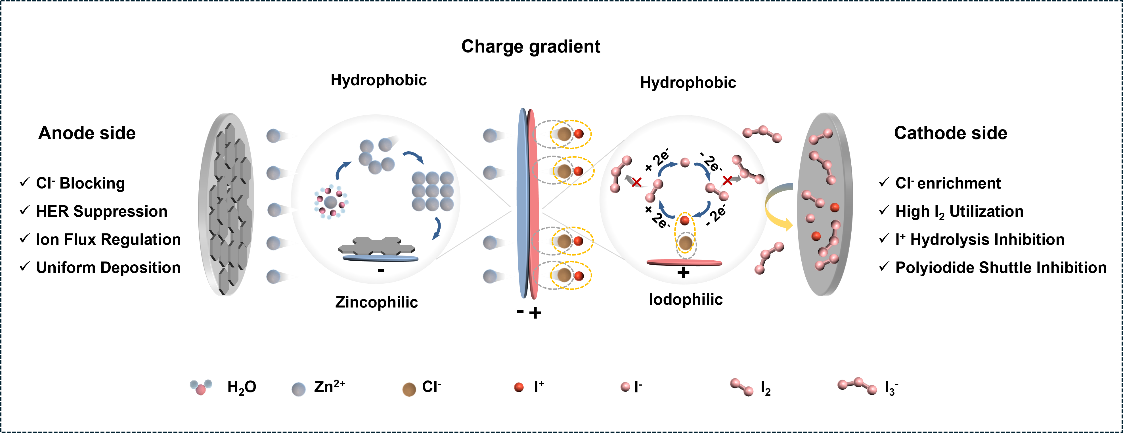
Diagram of diaphragm mechanism
To address these challenges, the research team developed a scalable separator featuring an asymmetric charge gradient and precisely regulated wettability, enabling effective control of the interfacial microenvironment in seawater-based zinc–iodine batteries. The asymmetric charge distribution drives Cl⁻ enrichment at the iodine cathode interface, creating a locally Cl⁻-rich microenvironment that stabilizes I⁺ intermediates. Meanwhile, precisely tuned wettability reduces interfacial water activity and effectively suppresses water-induced side reactions.
Benefiting from these features, the Zn–I₂ full cell exhibited a capacity decay of only 0.0013% per cycle after 50,000 cycles at 10 A g⁻¹. Stable operation was also achieved under demanding conditions, including a low negative-to-positive capacity ratio (N/P ≈ 2.5) and a temperature of −20 °C. The team further demonstrated an ampere-hour-level pouch cell with a capacity of approximately 1.3 Ah, which operated stably for more than 450 cycles.
This work provides a new strategy for developing high-performance and low-cost four-electron Zn–I₂ batteries. The study, entitled “Separator Engineering Enables Ah Level Four Electron Zn-I2 Batteries in Seawater Based Electrolyte,” was recently published in Energy Storage Materials. Dong Yanying, a 2023 doctoral student at the School of Materials Science and Engineering, is the first author, with Ocean University of China serving as the primary corresponding institution.
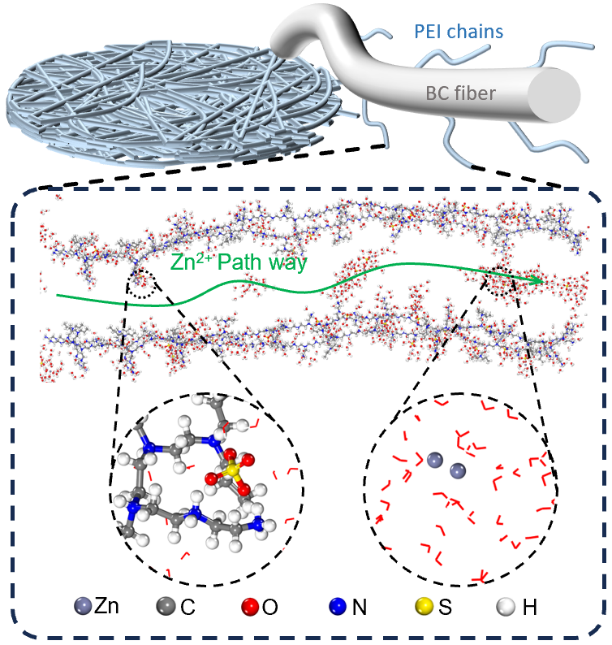
Schematic diagram of the separator's pH response ion gating mechanism
To overcome another limitation of conventional static functional separators—their inability to adapt to dynamically evolving electrolyte microenvironments and simultaneously stabilize both cathode and anode interfaces—the research team constructed a composite separator with pH-responsive ion-gating functionality.
Polyethyleneimine (PEI) molecules within the separator can reversibly adjust their conformation in response to changes in local pH. Under acidic conditions, the polymer chains extend to form ordered ion-transport channels, promoting uniform Zn²⁺ transport. In locally alkaline regions, the polymer releases protons to buffer the pH and mitigate local Zn²⁺ accumulation, thereby suppressing dendrite formation and parasitic reactions at their origin. Meanwhile, nitrogen-containing active sites reversibly capture polyiodide species, effectively inhibiting the shuttle effect.
Zn–I₂ batteries based on this separator delivered stable cycling for more than 64,000 cycles at 10 A g⁻¹, retaining 71% of their capacity with an ultralow capacity decay of only 0.00044% per cycle. Under a low N/P ratio of approximately 1.8, the cells maintained 88% of their capacity after 500 cycles. The corresponding pouch cells retained 81% of their capacity after 400 cycles and also exhibited excellent resistance to mechanical damage.
The study establishes a design paradigm based on pH-responsive dynamic ion gating for synergistic regulation of both cathode and anode interfaces, providing new mechanistic guidance for the practical development of long-life aqueous zinc–iodine batteries. The work, entitled “pH-responsive ion gating for durable aqueous zinc-iodine batteries,” was recently published in Advanced Functional Materials. Huang Haisheng, a 2024 doctoral student at the School of Materials Science and Engineering, is the first author, with Ocean University of China serving as the primary corresponding institution.
To address corrosion and dendrite growth at zinc metal anodes, the research team further developed a hydrogel electrolyte capable of controlled release. Under an applied electric field, the hydrogel releases a gallium–indium liquid metal onto the zinc anode surface, where it spontaneously forms an alloy with zinc.
This process enhances the corrosion resistance of the zinc anode, mitigates interfacial side reactions, promotes more uniform zinc deposition, and substantially extends the cycling life of zinc-ion batteries. Symmetric cells assembled with the hydrogel electrolyte achieved a cycling life of more than 6,000 h. Even at a depth of discharge of 42.7%, stable cycling was maintained for more than 1,200 h.
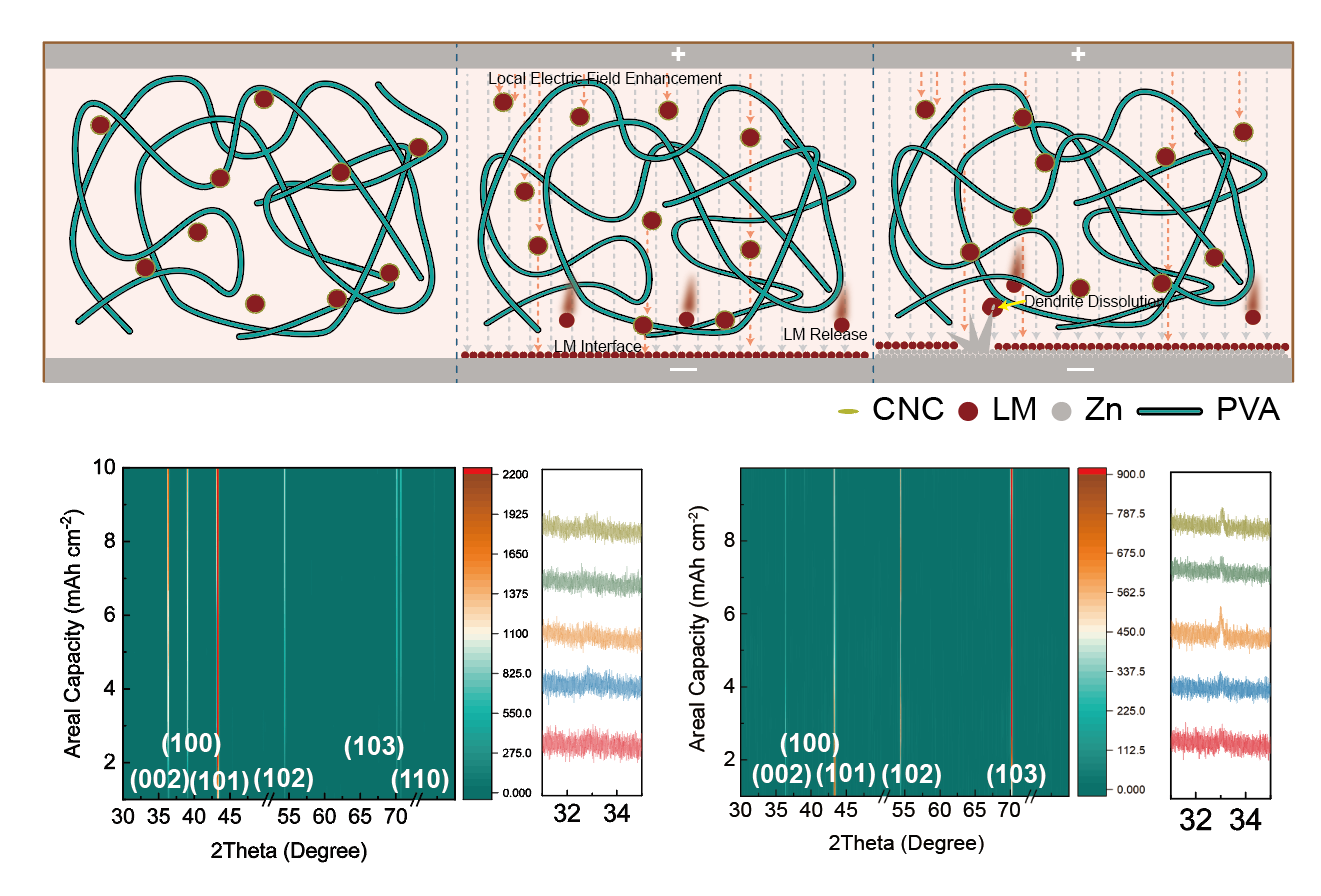
Schematic and characterization diagram of hydrogel-regulated zinc anode deposition
This work provides a viable route toward highly reversible zinc metal anodes and practical flexible aqueous zinc-ion energy-storage devices. The study, entitled “Composite Hydrogels with Controlled Liquid Metal Release for Dendrite Free Zinc Anodes,” was recently published in Advanced Energy Materials. Wang Xingjie, a 2023 doctoral student at the School of Materials Science and Engineering, is the first author, with Ocean University of China serving as the primary corresponding institution.
The above research was supported by the National Natural Science Foundation of China, the Natural Science Foundation of Shandong Province, the Qingdao Natural Science Foundation, and the Fundamental Research Funds for the Central Universities.
Original Articles: https://doi.org/10.1016/j.ensm.2026.105443
https://doi.org/10.1002/adfm.77435
https://doi.org/10.1002/aenm.71504
Text and Figures: Dong Yanying, Wang Xingjie, and Huang Haisheng