
From June 5 to 6, the 15th China Construction Bank “Challenge Cup” Shandong Provincial Undergraduate Entrepreneurship Plan Competition was held at the Laoshan Campus of Ocean University of China. Projects submitted by the School of Materials Science and Engineering achieved remarkable success, winning one First Prize and one Second Prize at the provincial level.
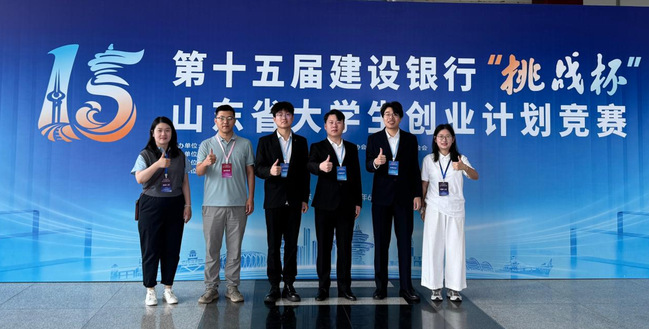
This year’s competition was jointly organized by the Communist Youth League Shandong Provincial Committee, the Shandong Provincial Department of Education, the Shandong Association for Science and Technology, and the Shandong Students’ Federation, and co-hosted by Ocean University of China and Shandong Polytechnic. Under the theme “Gathering Talent in Qilu, Challenging the Future,” the competition attracted more than 380,000 students from 160 universities across Shandong Province. A total of 1,300 projects advanced to the provincial competition stage. Following online evaluations and on-site defense sessions, 496 projects from 129 universities were shortlisted for the final round. Ultimately, 191 Special Prizes, 305 First Prizes, 319 Second Prizes, and 335 Third Prizes were awarded.
After extensive preparation and refinement, two projects from the School distinguished themselves among the finalists. The project “Deep Blue Shield—A Pioneer in Next-Generation Marine and Polar Protection Systems” won the Provincial First Prize, while “Turning Algae into Gold—Marine Carbon Materials Leading a New Paradigm for Blue Revitalization” received the Provincial Second Prize.
First Prize Project
Deep Blue Shield—A Pioneer in Next-Generation Marine and Polar Protection Systems
Team Members: Li Dehua, Han Zhenbang, Xiang Hao, Tang Zhaoguo, Wu Hao, Gao Chen, Jiang Jiachen, Liu Qianru, Teng Huaisheng, and He Yani
Faculty Advisors: Cui Zhongyu, Dong Fei, and Tian Huiyun
The Deep Blue Shield team focuses on overcoming critical corrosion protection challenges faced by strategic sectors such as naval vessels and deep-sea equipment. Leveraging the Engineering Research Center of Marine Materials and Protection Technology and the Marine Big Data Center cluster system, the team independently developed an intelligent cathodic protection system capable of providing corrosion protection across diverse marine environments. The technology addresses key limitations of conventional protection systems and has already been applied in ships, offshore engineering equipment, defense facilities, and other marine and polar engineering sectors. The project aims to promote innovation-driven talent cultivation while accelerating the integration of academic innovation, industrial development, and value creation, thereby supporting the high-quality transformation and clustered development of the marine materials protection industry.
Second Prize Project
Turning Algae into Gold—Marine Carbon Materials Leading a New Paradigm for Blue Revitalization
Team Members: Lan Wenhao, Shi Qisen, Qiu Chenglong, Zhu Chunliu, Ren Wancheng, Wang Zihan, Li Hekang, Zhang Yilin, Long Senwei, and Li Jincheng
Faculty Advisors: Wang Huanlei, Huang Minghua, and Dong Fei
The Turning Algae into Gold team is dedicated to the high-value utilization of algal biomass. By systematically addressing key challenges in the green production of carbon materials, the team has developed a low-carbon, energy-efficient, and environmentally friendly manufacturing route. Their technology effectively resolves long-standing issues associated with conventional processes, including high pollutant emissions and equipment corrosion. The resulting products have achieved internationally advanced performance levels while maintaining excellent environmental compatibility and operational stability. The team has published multiple influential papers in leading domestic and international journals and has filed several invention patents, establishing a comprehensive intellectual property portfolio. The technology has already demonstrated promising applications in new energy and environmental protection sectors, offering significant potential for industrial commercialization and socioeconomic benefits.
The School places great emphasis on innovation and entrepreneurship education and remains committed to the philosophy of “learning through competition, innovating through competition, and cultivating talent through competition.” Through initiatives such as curriculum reform, university-industry collaborative practice bases, and the Caizi Salon competition-sharing series, the School encourages students to align their innovative efforts with national strategic needs and translate research achievements into practical applications. These efforts aim to cultivate outstanding innovative talents capable of contributing to the development of new quality productive forces and the nation’s future technological advancement.
Text/Photos: Dong Fei