
Recently, the School of Materials Science and Engineering hosted the 182nd session of the Distinguished Overseas Scholars Lecture Series at the Caizi Lecture Hall on the West Coast Campus. Professor Ulrica Edlund, a member of the Royal Swedish Academy of Engineering Sciences and professor at KTH Royal Institute of Technology, was invited to visit the School and deliver a lecture entitled “Safe and Smart Materials and Devices for Water Purification.” Faculty members, researchers, and graduate students attended the event.
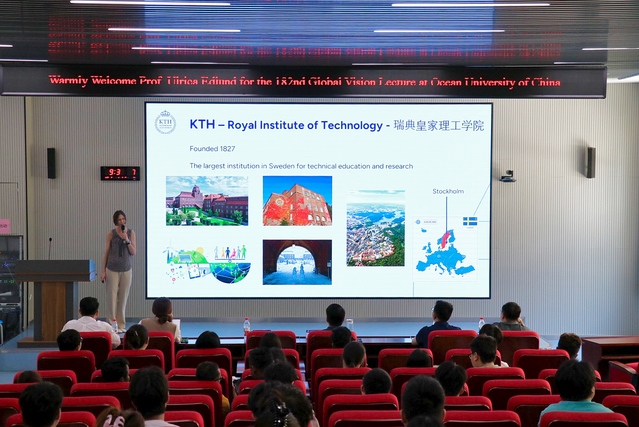
Scene from the Overseas Famous Teacher Lecture Hall.
During her presentation, Professor Edlund provided a comprehensive overview of recent advances in the development of renewable functional materials derived from marine and terrestrial biomass for water purification applications. She shared her team’s latest achievements in the valorization of algae and waste biomass resources and explained the design principles of renewable hydrogels and their intelligent responsive behaviors in water treatment systems. In addition, she introduced a non-destructive one-pot surface modification strategy and discussed the underlying mechanisms of biomaterial interface functionalization. The lecture sparked lively discussions, with faculty members and students actively engaging in the question-and-answer session.
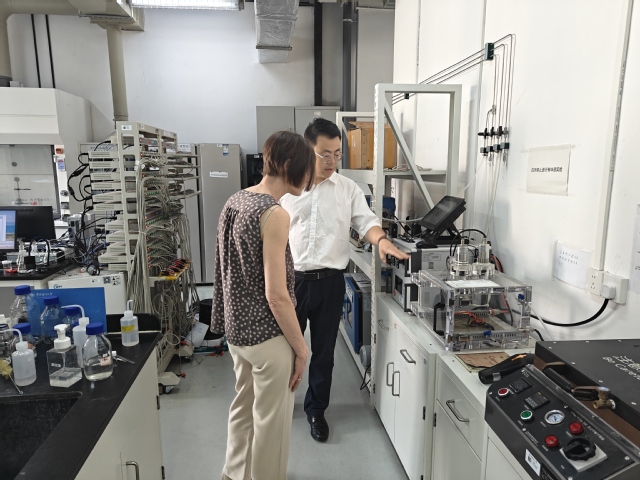
Professor Ulrica Edlund visited the laboratory
Following the lecture, Professor Edlund toured the School’s research laboratories and shared instrumentation facilities. She also held in-depth discussions with faculty members and students on potential collaborations in scientific research and talent cultivation.
Professor Edlund has long been engaged in research on polymer synthesis, surface modification, characterization, and materials design. Her work focuses particularly on the development of renewable functional materials from marine and terrestrial biomass resources, including algae, forestry biomass, and agricultural residues. She has made significant contributions to the development of renewable hydrogels and non-destructive one-step covalent surface modification techniques for biomaterials.
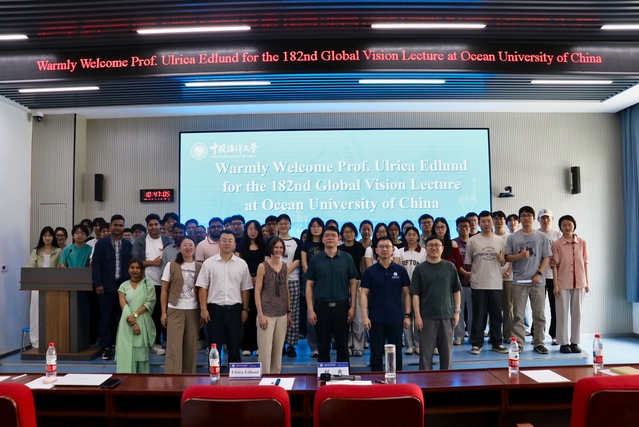
Group photo
The lecture not only enhanced participants’ understanding of biomass-based functional materials and emerging challenges in water purification but also created new opportunities for international collaboration and talent development in areas such as marine biomass valorization and green polymer-based functional materials.
Text: Zhang Wenyu
Photos: Lan Wenhao