
Author: Cui Hongzhi, Wang Huanlei, Liu Shuang
Source: China Education Daily
Date: April 29, 2026
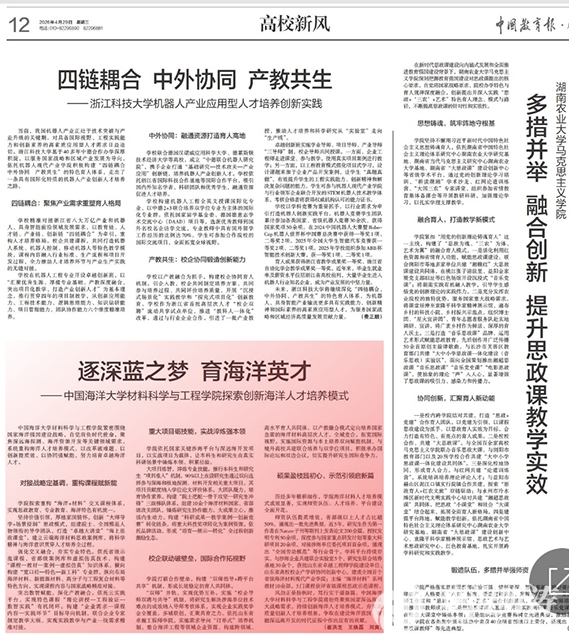
The School of Materials Science and Engineering at Ocean University of China remains closely aligned with the national strategy of building China into a maritime power. Guided by a strong sense of mission, the School focuses on key areas such as deep-sea exploration and marine resource development, systematically reforming its marine talent cultivation model through innovation-driven educational reform and collaborative empowerment to train outstanding professionals for the marine sector.
Aligning with National Strategy and Reforming the Curriculum System
The School has explored and established an interdisciplinary “Marine + Materials” curriculum system that integrates ideological and political education, disciplinary education, and marine characteristic into a unified framework.
Emphasizing value-based education, the School has cultivated students’ sense of patriotism and social responsibility through an innovative “master mentor + immersive learning” model. Guidance teams led by academicians and national role models have been established, alongside signature initiatives such as the “Distinguished Lecture Series” and “Maritime Ideological and Political Classroom.” A cloud-based repository of ideological and political teaching cases related to marine materials has also been developed, embedding scientific spirit and marine awareness throughout the entire educational process.
To strengthen interdisciplinary integration and disciplinary characteristic, the School has leveraged provincial-level model courses, teaching case repositories, and virtual simulation technologies to construct a comprehensive “course–textbook–case–simulation” knowledge system. Horizontally, it has developed a broad-based and characteristic-oriented engineering discipline cluster, while vertically establishing specialized tracks in marine materials, new energy materials, polymers, and engineering composites, ensuring close alignment between curriculum content and national strategic needs.
The School has also advanced digital and intelligent empowerment and deepened industry–education integration. Supported by a cloud-based practical teaching platform, characteristic courses now form an integrated loop of “theoretical instruction–engineering validation–digital practice.” Through a demand-oriented mechanism linking “industry needs–curriculum content–practical training,” enterprise experts participate in curriculum design to ensure close alignment between teaching and real-world industrial applications.
Cultivating Practical Skills through Major National Projects
Relying on national marine research platforms and deep-sea development projects, the School integrates undergraduate and graduate students into real scientific research environments to strengthen practical skills and innovation capacity.
Through a “project admission” mechanism, more than 90% of graduate students participate in major projects related to deep-sea and polar exploration as well as materials development. Their contributions are incorporated into thesis evaluation systems. The School has also established a three-tier research team structure of “academicians leading, core researchers advancing, and graduate students contributing,” forming more than ten national and provincial-level marine materials research teams to cultivate collaboration and teamwork.
In addition, the School has created a transformation chain linking “scientific achievements–teaching cases–innovation competitions.” Major scientific awards and research achievements are converted into educational resources, while innovation activities foster a comprehensive ecosystem integrating talent cultivation, achievement presentation, and achievement transformation.
Strengthening Industry Collaboration and Expanding International Vision
The School has broken traditional cooperation barriers by establishing a “dual-mentor + cross-platform sharing” mechanism, creating a stable and collaborative educational community.
Through a dual-mentor system jointly involving university faculty and industry experts, graduate students are guided in solving technical challenges faced by marine-related enterprises. Student performance in addressing industrial problems is incorporated into mentor evaluation systems, while enterprise-sponsored practice scholarships fully cover graduate students.
Supported by the Shandong Provincial Excellence Engineer College, the School has implemented a demand-oriented “customized training” model, integrating resources from marine engineering and related industries to cultivate urgently needed high-level marine materials professionals through industry–education integration.
The School also actively promotes international cooperation by combining global educational resources with localized training. Joint degree and exchange programs have been established with overseas universities, while international forums and bilateral conferences are regularly organized to enhance students’ global competence and international competitiveness.
Remarkable Achievements and Continued Commitment
After years of dedicated effort, the School’s marine materials talent cultivation model has produced remarkable results across faculty development, talent training, and platform construction.
More than 50% of faculty members hold provincial- or ministerial-level talent titles, and numerous outstanding role models have emerged. Over the past five years, graduate students have published more than 200 papers as first authors in journals including Nature family journals, obtained over 50 invention patents, and participated extensively in national key R&D projects and commissioned projects from marine-related organizations. Many graduates have become leading professionals in the marine industry, including recipients of honors such as “National Model Worker.”
The School has also continuously strengthened its disciplinary and research platforms, jointly establishing five collaborative laboratories and more than 30 graduate training bases with marine enterprises. It has been approved as a construction unit for the Shandong Provincial Excellence Engineer College and the Shandong University–Enterprise Collaborative Innovation Center, and has established China’s first provincial-level Modern Industrial College of Marine Materials. More than ten textbooks in the “Marine Materials” series have been compiled, and five courses have been recognized as provincial-level model courses for curriculum-based ideological and political education.
As China advances toward becoming a maritime power, the School of Materials Science and Engineering at Ocean University of China will continue to focus on major national deep-sea strategic needs, further innovate marine talent cultivation models, and strengthen the foundation for high-quality innovative talent cultivation, contributing to marine development and deep-sea exploration in the new era.
Editors: Zuo We
Responsible Editor: Zuo We