
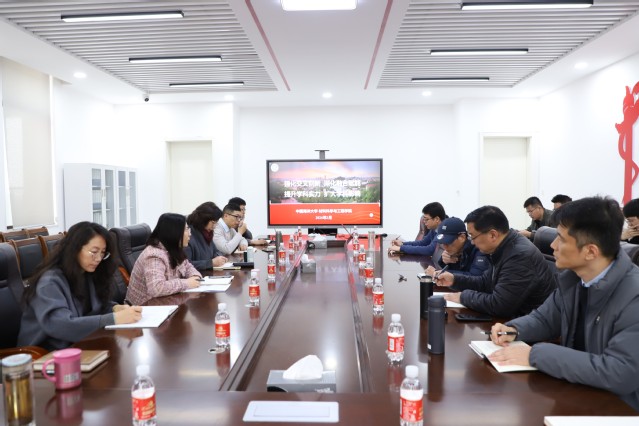
On March 24, the School of Materials Science and Engineering convened its 2026 Development Strategy Symposium and Professors’ Assembly. The meeting was chaired by Party Secretary Du Junhua.
In her remarks, Dujunhua noted that the meeting served both as a mobilization to build consensus and as a strategic deployment to advance key initiatives. She emphasized that 2026 marks the opening year of the 15th Five-Year Plan period, a critical juncture for the School amid profound changes in the higher education landscape and intensifying disciplinary competition. She called on faculty members to strengthen their sense of mission and responsibility, seize emerging opportunities, and actively contribute to the School’s development. She stressed the importance of aligning individual academic pursuits with institutional goals and fostering a shared commitment to advancing the School to new heights.
Dean Cui Hongzhi delivered a keynote report titled “Strengthening Interdisciplinary Innovation, Deepening Integration and Empowerment, Enhancing Disciplinary Strength, and Expanding Academic Influence.” The report provided a comprehensive review of the School’s achievements during the 14th Five-Year Plan period, outlined the strategic framework for the 15th Five-Year Plan, and identified key priorities for 2026. Cui highlighted the need to promote interdisciplinary innovation, deepen internal reforms, and accelerate high-quality development. She also underscored the importance of cultivating distinctive research strengths—particularly in advanced marine materials—and advancing integration-driven development along the strategic directions of being “application-oriented, high-level, broad-based, and forward-looking.”
Members of the School’s leadership team and department heads presented analyses and proposals based on their respective areas of responsibility. Participants engaged in in-depth discussions and offered constructive recommendations for the School’s future development.
The meeting was attended by members of the School leadership, Party Committee members, heads of departments and research centers, Party branch secretaries, all professors, and representatives of early-career faculty, totaling nearly 40 participants.
Text/Photos by: Li Wei