
Recently, a research team led by Professor Xiaofeng Xu from the College of Materials Science and Engineering at Ocean University of China (OUC) published a research article entitled “Hygroscopic Core−Shell Matrices via Coaxial Multi-Material Printing for Tailored Atmospheric Water Sorption” in the internationally leading materials journal Advanced Functional Materials. The study reports the design and fabrication of hygroscopic core–shell matrices with Janus structural characteristics using coaxial multi-material 3D printing, achieving efficient and stable adsorption–desorption cycling of atmospheric water across a wide humidity range. The developed materials demonstrate strong potential in applications such as atmospheric water harvesting, humidity regulation, and photovoltaic cooling.
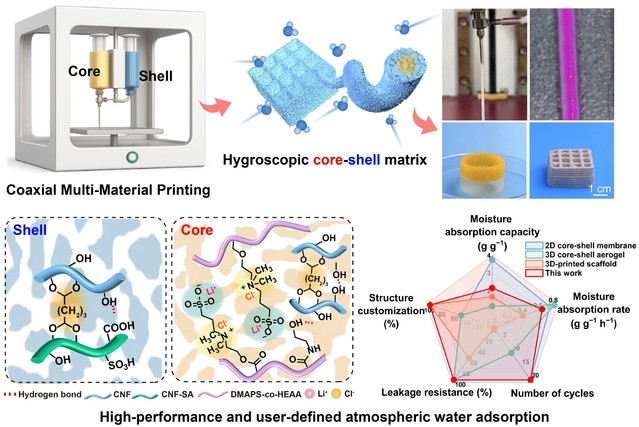
Schematic diagram of the performance of the core-shell matrix, multiple cross-linking network and hygroscopic matrix prepared by coaxial 3D printing
Atmospheric water harvesting technologies offer promising solutions for alleviating freshwater scarcity, enabling humidity management, and achieving passive cooling. However, conventional salt-based hygroscopic materials—such as aerogels and hydrogels—often suffer from limited structural tunability, restricting their integration and optimization in complex application scenarios. To address these challenges, the research team developed 3D-printed hygroscopic core–shell matrices via coaxial multi-material printing (as shown in the figure).
In this design, the shell ink, based on cellulose nanofibers, was modified through acrylic grafting to form a highly porous aerogel structure, providing rapid vapor transport pathways and excellent capillary absorption capability. The core ink incorporated LiCl as the hygroscopic component and introduced a zwitterionic copolymer P(DMAPS-co-HEAA). Through electrostatic interactions between its charged functional groups and Li⁺/Cl⁻ ions, the copolymer enhances mechanical strength and structural stability while effectively suppressing salt migration and leakage. Using a coaxial nozzle, the core and shell inks were simultaneously extruded and subsequently crosslinked in situ under UV irradiation, forming a three-dimensional hygroscopic matrix in which each filament possesses a distinct core–shell heterostructure. This filament-level structural design synergistically improves specific surface area, mass transfer pathways, salt retention, and solution uptake performance.
Experimental results show that the core–shell matrix achieves a water uptake of 2.15 g g⁻¹ at 90% relative humidity within 24 hours, and releases 92% of the absorbed water within 30 minutes at 90 °C, while maintaining stable performance over 50 adsorption–desorption cycles without noticeable degradation. Compared with conventionally printed single-material hygroscopic matrices, the core–shell structured materials exhibit clear advantages in structural versatility, adsorption rate, and long-term stability. The technology enables precise regulation of pore structures in hygroscopic materials and further enhances water transport and adsorption efficiency through optimization of shell composition and microstructure.
This work represents the first demonstration of constructing structurally heterogeneous hygroscopic composites via coaxial 3D printing, offering a customizable material and fabrication strategy for applications in humidity control, atmospheric water harvesting, and evaporative cooling. The study provides a systematic exploration spanning material design, 3D structural fabrication, and multi-scenario application validation, introducing coaxial multi-material printing as a powerful approach for hygroscopic composite development.
The first author of the paper is Xiaochun Wu, a Ph.D. candidate (Class of 2022) from the College of Materials Science and Engineering. This research was supported by the National Natural Science Foundation of China, the Shandong Natural Science Foundation, the Qingdao Natural Science Foundation, and benefited from collaborations with international partners from the United Kingdom, Sweden, and Finland.
Text/Images: Xiaochun Wu